
INDUSTRY INSIGHT
The Science of
Kiln Drying
Conventional and Continuous Kilns, Moisture Content, and Why It Matters for Radiata Pine
Every pack of sawn Radiata Pine in New Zealand starts its journey green, often containing more than 100 per cent moisture relative to its dry weight.
 RADIATA PINE · KILN DRYING
START HERE
How controlled drying turns green Radiata Pine into stable, predictable timber — and what buyers should check on delivery.
Kiln drying reduces moisture in a controlled environment, transforming raw timber into a stable, predictable material.
Every pack of sawn Radiata Pine in New Zealand starts its journey green, often containing more than 100 per cent moisture relative to its dry weight. Kiln drying (KD) reduces that moisture in a controlled environment, transforming raw timber into a stable, predictable material. Whether a mill uses conventional batch kilns or continuous kilns, the goal is the same: to reach a specified moisture content so the timber performs reliably from the yard to the finished job.
Both methods are widely used in New Zealand and can produce high-quality timber that meets industry standards when operated correctly. This article explains how each works, why moisture content targets matter, and what buyers should check on delivery.
Why Kiln Dry Timber?
Kiln drying is more than a way to accelerate the natural drying process. It is a fundamental requirement for modern construction and export markets.
Dimensional Stability
Reduces warping, twisting, and movement after installation.
Increased Strength
Strength improves as moisture content drops below fibre saturation.
Treatability & Gluability
Improves absorption of adhesives and preservatives.
Biological Resistance
Reduces mould, blue stain, and fungal growth risk.
Phytosanitary Compliance
Meets export standards by eliminating insects and larvae.
Reduced Transport Weight
Lowers freight cost by removing excess water weight.
Moisture Content Targets & Timber Dimensions
In New Zealand, kiln-dried structural Radiata Pine is commonly dried to around 12–16% moisture content (MC), although specific targets can vary by product and supplier.
Treatment and hazard class are separate from kiln drying, but treatment can affect the timber’s moisture content. For H1.2 internal framing, boron treatment temporarily increases MC. New Zealand mills generally kiln dry the timber again after treatment. As a result, H1.2 framing is typically supplied at up to 18% MC, while retaining the dimensional stability expected of kiln-dried structural timber.
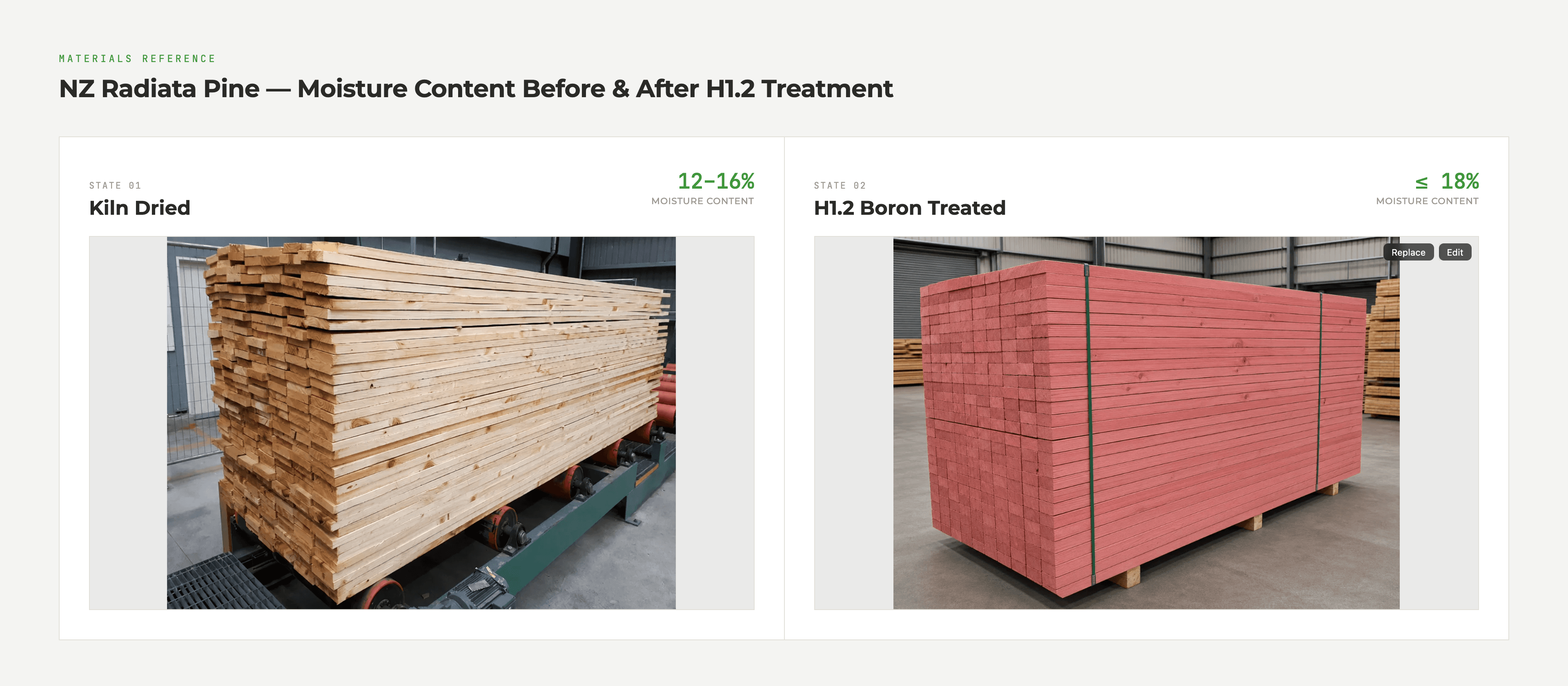
The visual is kept fully contained so moisture targets and treatment information remain legible.
Under NZS 3604:2011, New Zealand’s timber-framing standard, framing timber must be at or below 20% MC before the building is closed in, meaning before wall and ceiling linings are installed.
Typical indoor equilibrium moisture content in New Zealand is around 12–15%. This is the range timber naturally moves towards once installed and exposed to normal indoor conditions. Timber installed above this range may continue to dry after enclosure, resulting in shrinkage and movement, including gaps, distortion and fixing issues.
for structural Radiata Pine
(NZS 3604:2011)
(typical range)
Thickness, Width, and Drying Time
Thicker and wider boards take longer to reach the same target moisture content (MC) than thinner material because moisture must travel from the core to the surface before it can escape. The greater the thickness, the longer this path, which slows the drying process. If thick sections are forced to dry too quickly, the outer layers dry and shrink first while the core remains wetter and swollen. This difference creates internal stress because the outer shell is tightening around a still-expanded core, which can lead to collapse or internal checking. For this reason, drying schedules are adjusted based on section size, and mixing significantly different thicknesses in the same kiln charge requires careful control.

A calibrated pin-type moisture meter is the standard tool for verifying MC specifications on delivery.
Conventional Batch Kilns
In a conventional batch kiln, a fixed stack of timber is loaded into a sealed chamber. Temperature, humidity, and airflow are controlled according to a schedule tailored to species, section size, and target MC. Once the charge reaches target, a conditioning phase is typically applied, reintroducing steam to equalise moisture between boards and relieve residual drying stress.
Conventional kilns are the most common type used by New Zealand mills and remain the backbone of the industry worldwide. Their flexibility is a genuine strength: mills processing mixed section sizes or specialty orders can adjust the schedule for each charge in ways a continuous kiln cannot easily accommodate. The capital cost is also substantially lower than a continuous system, which is why many mills continue to use this technology.
A well-managed conventional kiln, with a properly calibrated schedule, adequate conditioning, and experienced operators, is fully capable of producing timber that meets the New Zealand's standards (NZS 3631:1988 and AS/NZS 4787:2001). Because the stack is stationary, airflow is not perfectly uniform throughout the pack, particularly toward the centre. Without a thorough conditioning phase this can result in wider MC variation between boards. Quality of outcome depends significantly on schedule design, kiln maintenance, and operator experience.
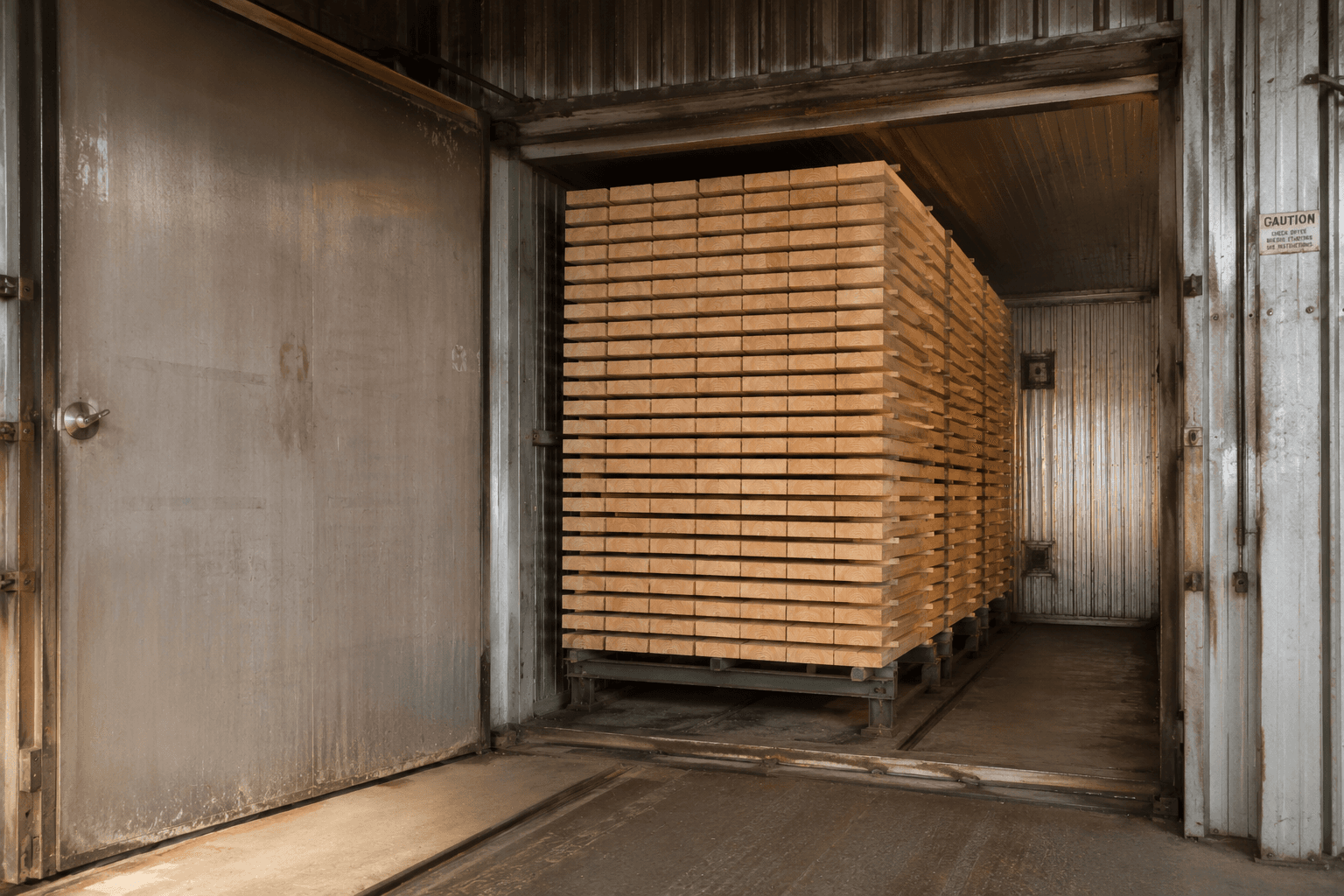
Conventional batch kilns allow flexible scheduling across mixed section sizes, the industry standard across NZ mills.
Continuous Kilns

Continuous kilns move timber through a fixed drying environment, delivering tighter moisture distribution at scale.
A continuous kiln (also called a progressive or counter-flow kiln) moves timber slowly through a long tunnel. Green timber enters at one end and dried timber exits at the other. The counter-flow design recovers energy efficiently: heat from the exiting dried timber pre-heats the incoming green timber, while moisture from the wet timber naturally conditions the drier lengths. Research indicates this delivers thermal energy savings of approximately 30% compared with conventional batch kilns.
Because each board passes through the same fixed drying conditions in sequence and residence time is consistent, continuous kilns tend to produce tighter moisture distribution across a pack. They can run 24 hours a day, supporting more predictable throughput at high volumes. However, they require significantly higher capital investment and are generally optimised for a specific section size and species, making them less flexible for varied products.
Because every board passes through identical drying conditions in sequence, continuous kilns tend to produce tighter moisture distribution across a pack.
Comparing the Two: A 2022 Study
A 2022 peer-reviewed study by Kumar et al. (BioResources) compared a continuous kiln against ultra-high temperature (HTD) batch drying for Queensland plantation-grown southern pine, a plantation softwood closely related to Radiata Pine, using AS/NZS standard test methods.
Primary research: Kumar et al. (2022), BioResources.
Key Findings: Continuous Kiln vs Ultra-High Temperature Batch Drying (HTD)
Coefficient of variation in moisture content, HTD process versus continuous kiln
Boards showing internal checking, HTD process versus continuous kiln
Higher resin accumulation in the HTD process due to elevated temperatures
Drying stress and moisture gradient significantly reduced in continuous kiln boards
Note: This study compares a continuous kiln against ultra-high temperature batch drying (up to 180°C), not against conventional batch kilns running at moderate temperatures with proper conditioning. The study is most useful for understanding how drying temperature and method affect quality outcomes, not as a blanket assessment of all conventional kilns. It is also one of the few direct comparisons available, so while the results are notable, further testing is needed to confirm performance across a wider range of conditions. Well-operated conventional kilns using optimised schedules regularly produce timber that meets all relevant NZ standards.
Conventional vs Continuous: At a Glance
| Attribute | Conventional Batch Kiln | Continuous Kiln |
|---|---|---|
| MC Consistency | Varies with schedule and conditioning quality | Tight distribution at scale |
| Energy Efficiency | Standard | ~30% savings via counter-flow |
| Flexibility | Adjustable per charge, mixed sections | Optimised for specific section/species |
| Capital Cost | Substantially lower | Significantly higher investment |
| Throughput | Batch cycles | Continuous, 24/7 operation |
| NZ Standard Compliance | Capable when well-managed | Capable when well-managed |
What This Means on Delivery
The key consideration is not which kiln type was used, but whether the finished timber meets the moisture content, dimensional stability and quality requirements for its intended use. Both batch and continuous kilns can produce compliant timber when operated correctly.
All kiln-dried timber purchased through FPX is checked at the mill to confirm it is within the required specification before dispatch. The aim is for the timber to arrive ready for its intended application, with moisture content and product quality consistent with the listed specification.
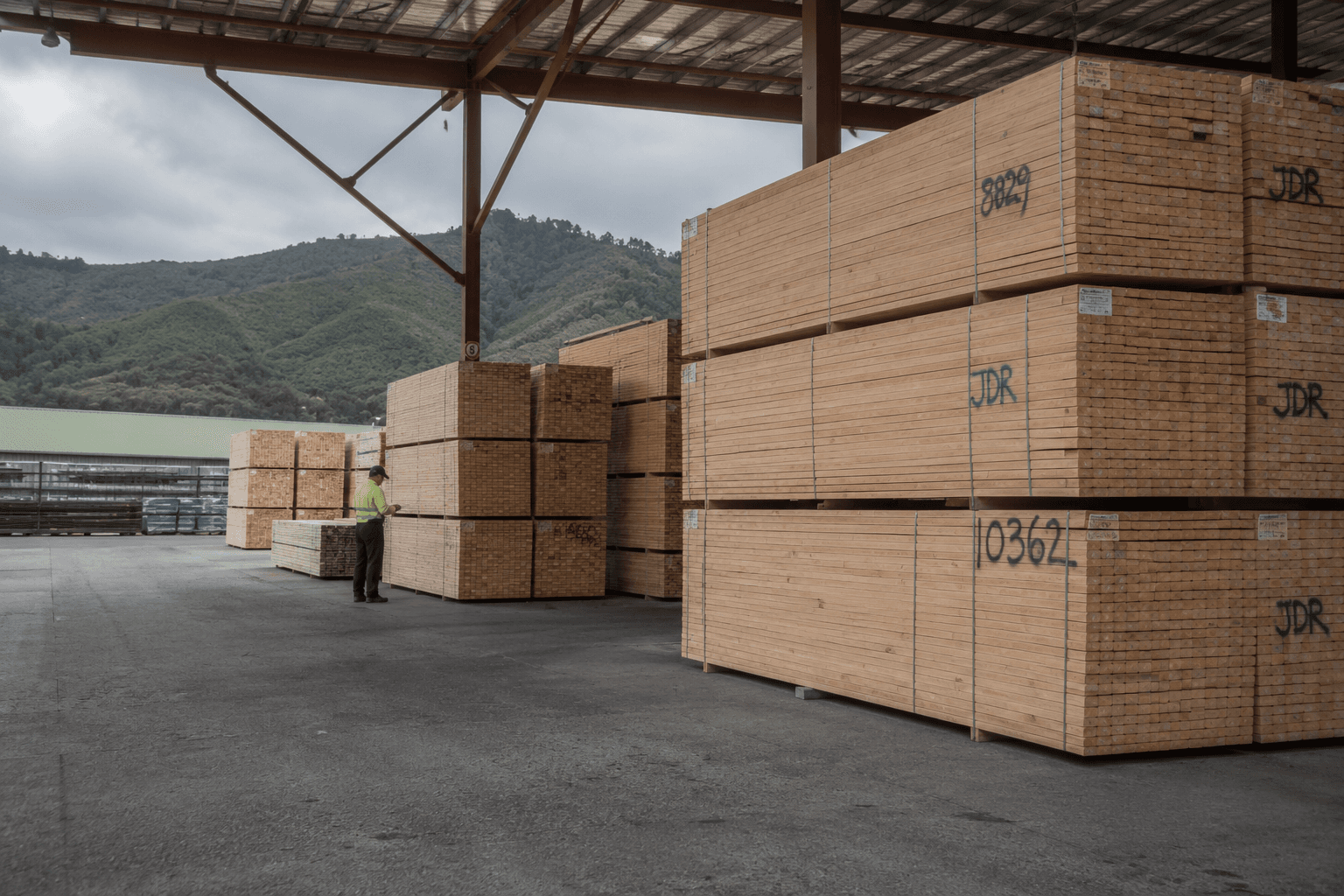
Kiln-dried timber purchased through FPX is checked at the mill to confirm it meets the required specification before dispatch.
Radiata Pine Sourcing
with a Clear Way In
Purchasing decisions should be guided by whether timber meets the relevant grade, moisture and product specification for its intended use. FPX is a digital timber sourcing service for commercial buyers in New Zealand, supported by practical timber expertise behind the platform.
Buyers can browse available timber, review current offers or send FPX a specific timber requirement. For a defined requirement, including dimensions, grade, treatment, quantity and timing helps keep the sourcing brief clear from the start.
The website helps buyers understand the timber and sourcing options before moving into the detailed commercial requirement.
Need Radiata Pine to a specific requirement?
Browse available timber or send FPX the specification you already have.
Neither Kiln Type is Inherently Superior. Execution is Everything.
Kiln drying transforms green Radiata Pine into a stable, strong, and export-ready material. Conventional batch kilns remain the most widely used technology in New Zealand, offering flexibility, lower capital cost, and a proven track record across a wide range of grades and section sizes. Continuous kilns offer advantages in energy efficiency and moisture uniformity at scale. Neither type is inherently superior for all situations, and both produce timber that meets NZ standards when properly managed.
Ultimately, kiln performance comes down to how well the process is controlled. Consistency in moisture content reflects operational discipline, process management, and experience, not just kiln type. FPX supports this by providing the visibility and structure needed to account for the variables that impact quality, consistency, and reliability. This helps buyers make more informed sourcing decisions and secure timber that meets specification.
Consistency in timber quality comes from disciplined processes and clear visibility. Focus on specification, understand the variables, and make decisions with confidence.
SOURCES
Research and industry references.
This article draws on publicly available research and industry resources for accuracy. Key references include:
- Kumar, C., Faircloth, A., Leggate, W., and Redman, A. (2022). Impact of continuous drying method on drying quality of southern pine sawn timber. BioResources 17(1), 574–591.
- Leggate, W., Kumar, C., McGavin, R.L., Faircloth, A., and Knackstedt, M. (2021). The effects of drying method on the wood permeability, wettability, treatability, and gluability of southern pine from Australia. BioResources 16(1), 698–720.
- Rahimi, S., Nasir, V., Avramidis, S., and Sassani, F. (2023). The role of drying schedule and conditioning in moisture uniformity in wood: A machine learning approach. Polymers 15, article 792.
- Andersson, S. (2008). Drying of timber in progressive kilns. Wood Material Science and Engineering 3(1–2).
- Cown, D.J. (1999). NZ Radiata Pine and Douglas-fir: Suitability for Processing. Forest Research Bulletin No. 216. New Zealand Forest Research Institute.
- International Plant Protection Convention (IPPC). ISPM 15: Regulation of wood packaging material in international trade.
- NZS 3604:2011. Timber-framed buildings. Standards New Zealand.
- NZS 3631:1988. New Zealand Timber Grading Rules. Standards New Zealand.
- AS/NZS 4787:2001. Timber — Assessment of Drying Quality. Standards Australia / Standards New Zealand.
- Red Stag Timber. Measuring Moisture in Timber.
NEXT IN INDUSTRY INSIGHTS
More timber knowledge from FPX.
Explore practical guides covering timber characteristics, processing, specifications and sourcing.